Metroid Prime 4 evolves a classic formula into something bigger, stranger, and more ambitious, but does it hold together?
This is a difficult game for me to review. The original Metroid Prime is one of my two favourite video games of all time. From the squelchy, Doctor Who–influenced title screen music to its intricate environments and melancholic atmosphere, all the way through to its wild, thumb-breaking conclusion, everything about Samus’ adventure on Talon IV is strange, lonely, and completely absorbing.
That first playthrough was genuinely transformative, and my feelings about the game today are a mix of warm nostalgia and awe after two decades spent dissecting its design. I don’t expect any game to surpass my appreciation for it, so in that context, Metroid Prime 4 has an unenviable job.
Things get off to a positive start, thankfully, with a bombastic opening sequence that doesn’t match Prime’s iconic introduction, but is immediately reassuring and familiar. Everything feels just as it should, even though the Nintendo GameCube’s idiosyncratic control scheme has long been retired.
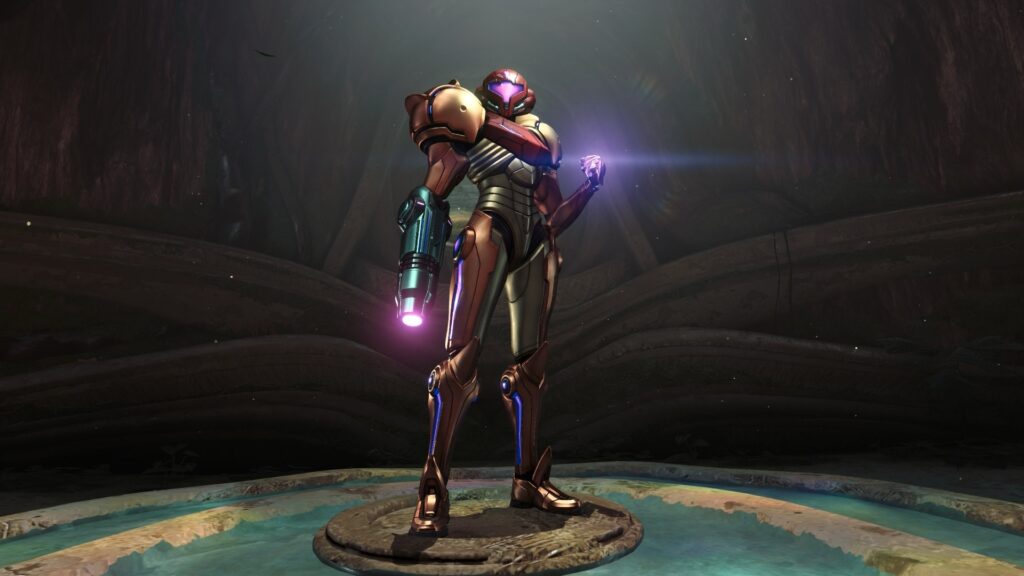
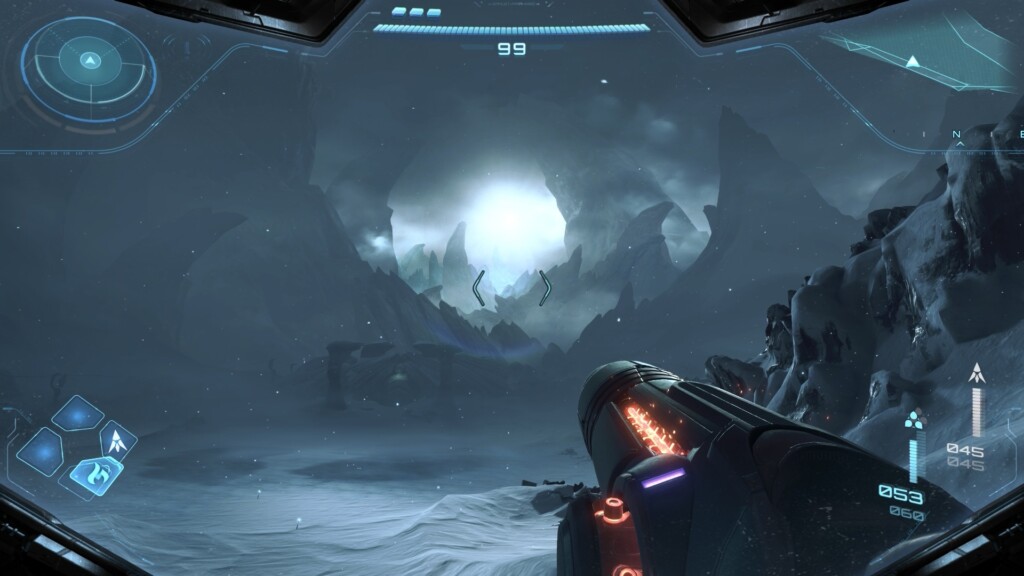
The first Prime stripped Samus of her abilities and left her to recover them as she gradually uncovered the mysteries of Talon IV. Metroid Prime 4 takes a similar approach, but on a much larger canvas. The scale here is more intergalactic, more mythic. This is Metroid by way of sweeping 1970s pulp sci-fi, with expansive vistas, ancient cultures, and ruins that feel inscrutable and unknowable. Long-forgotten civilisations are integral to the series, but Retro has taken the art direction far enough for it to feel truly alien again.
The planet of Viewros is simply stunning. The Nintendo Switch 2 (and its humble predecessor) might not have the raw horsepower of a PS5 or Xbox Series X, but Metroid Prime 4 plays to the system’s strengths. The game’s visuals are consistently strong, with exquisitely constructed environments, fantastic enemy designs, and cutscenes framed with a cinematic eye. It’s a striking game not because it chases realism, but because it commits to a clear, coherent aesthetic. Metroid Prime 4 is not as oppressive or claustrophobic as some purists might prefer, but the gloss, the scale, and the sense of spectacle are hard to resist. It’s quite the thing to see in a game from Nintendo.
Against this backdrop, Samus seems smaller and more vulnerable, but this time she’s not entirely on her own. For the most part, this is still a solitary adventure, but a handful of NPCs drift in and out of the story to lend a hand, and they have proved divisive.
There’s a strand of Metroid fandom, one I’m sympathetic to, that prefers Samus as a lone professional, moving quietly through hostile spaces. Metroid Prime 4 pushes against that by treating her more openly as a figure of reputation. No one actually stops her mid-boss fight for a selfie or autograph, but the enthusiasm comes close.
Myles MacKenzie, who has been the subject of much derision, turns out to be fairly innocuous. He doesn’t add much, but neither does he puncture the atmosphere. If anything, Samus herself seems similarly unimpressed, and her trademark silence reads as cool disdain. On that front, at least, the die-hard fans are in good company.
The other part-time companions Samus encounters along the way are equally inessential but better realised, with the highlight being the world-weary sniper, Reger Tokabi. Given the scale of the overworld, which is not enormous but still significant, having these side characters chime in with advice and direction can, I admit, be helpful.
By contrast, the much-vaunted Sylux ultimately sits on the lower rung of Metroid villains, an oddly small-scale foe compared to the cosmic weirdness playing out elsewhere.
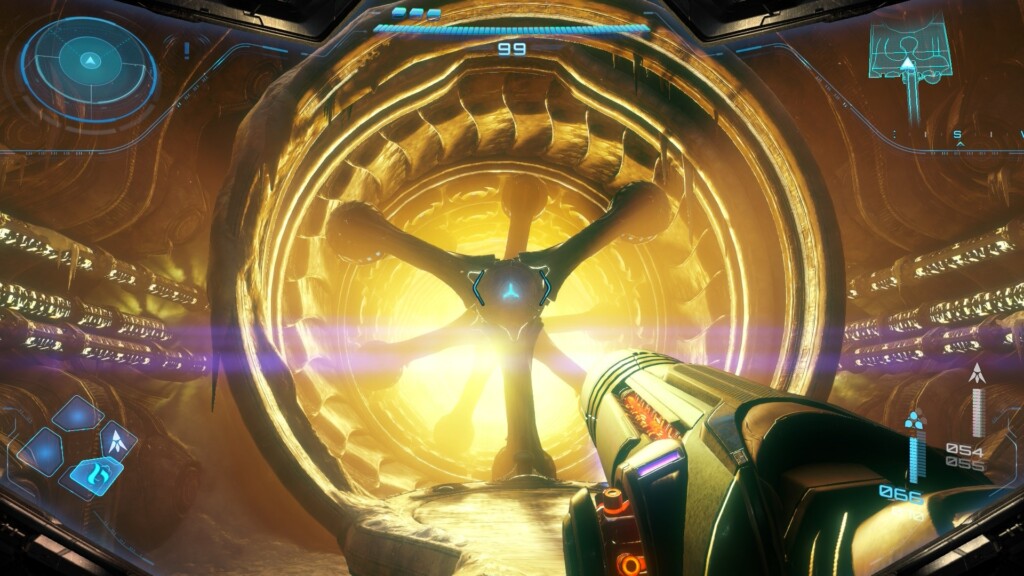
For the most part, however, the classic Prime loop remains intact. Samus moves through environmentally distinct areas that gradually unfurl and then fold back on themselves, guided by the teasing hum of hidden power-ups waiting to be claimed and paths yet to be unlocked. There’s a risk the formula might taste stale, but given this is only the fourth entry in two decades, its familiarity feels comforting rather than tired. It’s a thrill to lose yourself in these spaces, especially as so few other games trade in this blend of first-person action, puzzle-solving, and exploration. Areas such as the Volt Forge, Ice Belt, and Flare Pool are up there with the best, and each provides a slightly different spin on that core loop.
The connective tissue between these areas is a sparse desert overworld that functions much like Hyrule Field in The Legend of Zelda: Ocarina of Time. There’s not much to do out here, but the emptiness is oddly effective and recalls the unsettling planetary excursions of the original Mass Effect.
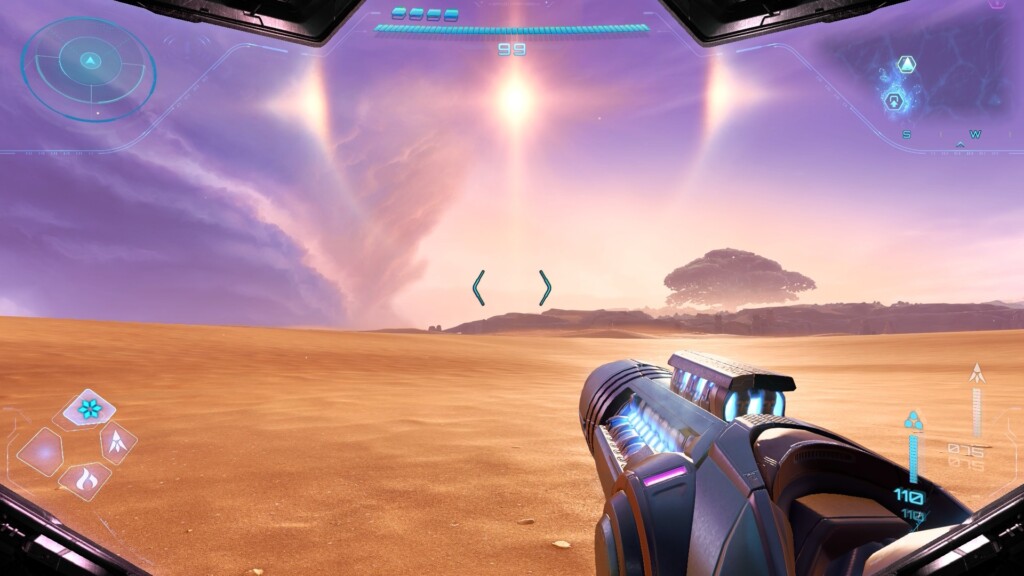
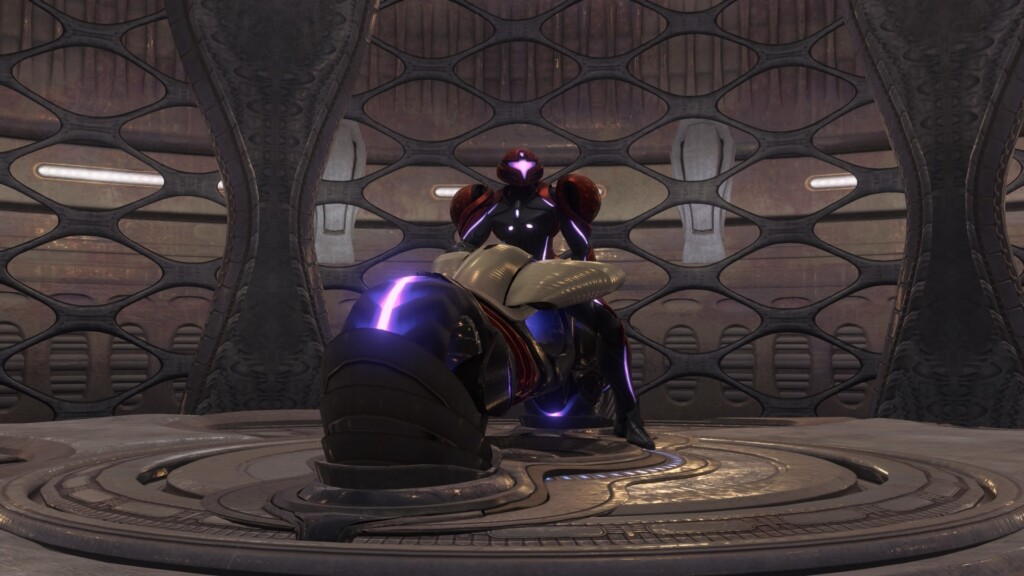
Traversal across this expanse is handled by Vi-O-La, a souped-up set of wheels, which lets Samus skim quickly across the landscape in pursuit of her next objective. Vi-O-La is a joy to control, and the road to unlocking the vehicle is one of the game’s highlights, a focused, cleverly constructed excursion that essentially asks Samus to earn her licence. It’s a ridiculous idea on paper – a galactic bounty hunter reduced to a driving test – but when the guitars are wailing and you’re putting pedal to the metal, it’s hard to resist the detour. It’s something genuinely new, and I’m here for it, and for a potential Metroid bike-racing spin-off.
The psychic framing for Samus’ new range of abilities is also effective, even if many are familiar powers dressed up in new clothing. One in particular feels like a knowing wink back to Batman: Arkham Asylum, which itself owed a debt or two to the first Prime.
I’ve always liked how the Metroid Prime games bring a sense of tactility and connection to the world. Several of the more hands-on interactions from earlier titles return, each comfortably mapped to the thumbsticks, with optional motion or mouse controls if you want them. Combined with the delicate use of HD Rumble and its upgraded equivalent on Switch 2, they give simple actions like opening doors, powering up machinery, or grappling items a real sense of physicality. It’s an evolution of Metroid Prime 3’s Wii Remote flourishes, but it’s more refined, more comfortable, and certainly more precise.
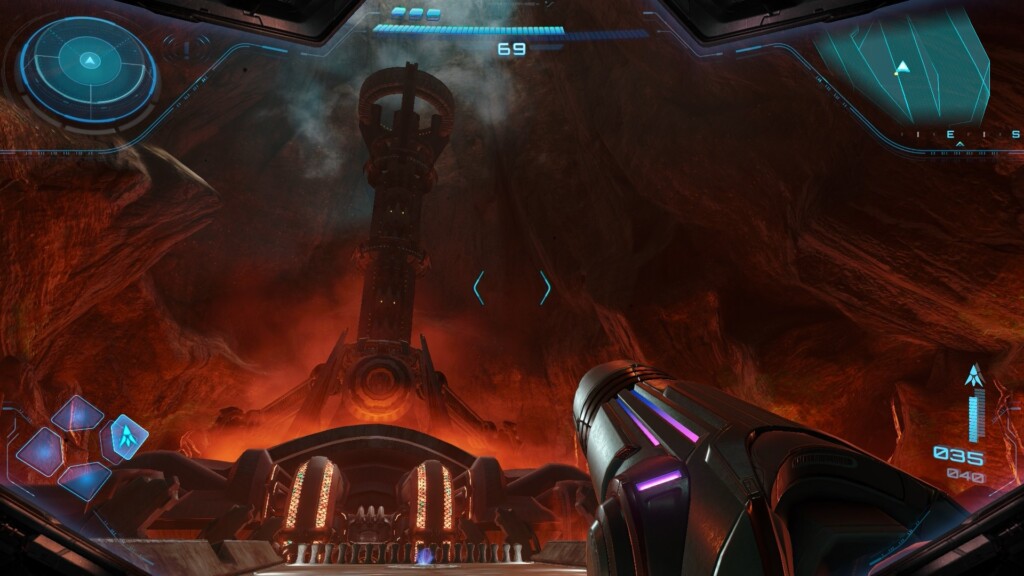
Metroid Prime 3 is the game that kept coming to mind as I played. Retro’s Wii-era entry is often overlooked, and although it has a few rough edges, it’s a solid, atmospheric experience. Metroid Prime 4 is cut from the same cloth. Its core is as pleasurable, reliable, and engaging as ever, but the framing, both in narrative and overall structure, is where Retro finds room to be more experimental and playful. Not every decision pays off, but I’d rather the studio reach than retreat. I’d rather Samus ride a space motorbike than take another elevator to her next objective. I’d rather have a space nerd tip me off to a location than wander aimlessly for hours. I’d rather see an idea that doesn’t quite land than a safe retread of old ground.
You can nitpick some of Retro’s decisions, but taken as a whole this is an intricate and absorbing sci-fi adventure that’s much more than the sum of its parts. Forget the extended cast of NPCs and focus on the meticulous level design, the outrageously good soundtrack, the reams of scannable lore, and the top-class boss encounters.
I hope the game is successful enough for Retro to be tasked with developing a fifth entry, because I’d love to see what the team could do freed from the lingering constraints of designing around the original Switch’s hardware. The fact that Metroid Prime 4 doesn’t surpass the original does not make it a failure. It sits comfortably alongside its predecessors, improves on 2 and 3 in several respects, and, most importantly, proves there is still a place for the series in today’s video game landscape.