Hyrule Warriors: Age of Imprisonment tells a sweeping war story that makes the Musou formula feel essential.
There’s nothing better than when a video game just surprises you. Whether it’s a mechanic, a character, a piece of level design, or just the level of polish that helps create a specific experience. Games cast their spell when they give me something I didn’t know I wanted or expected.
I had some sense that Hyrule Warriors: Age of Imprisonment was going to impress when I previewed it earlier this year. It seemed to have a level of quality and artistry that transcended that of a typical second-tier spin-off, which, to be honest, is how I have always considered this series.
As a Wii U owner, I devoured 2014’s original Hyrule Warriors as I was so starved of games. It was a lot of fun, for what it was, but repetitive and ultimately a bit of a grind. I didn’t play too much of Hyrule Warriors: Age of Calamity, which came to the Nintendo Switch in 2020, but there were evident advancements in the formula. Fire Emblem Warriors: Three Hopes offered further evidence with evolved gameplay mechanics and a narrative that was actually additive to the Fire Emblem: Three Houses source material.
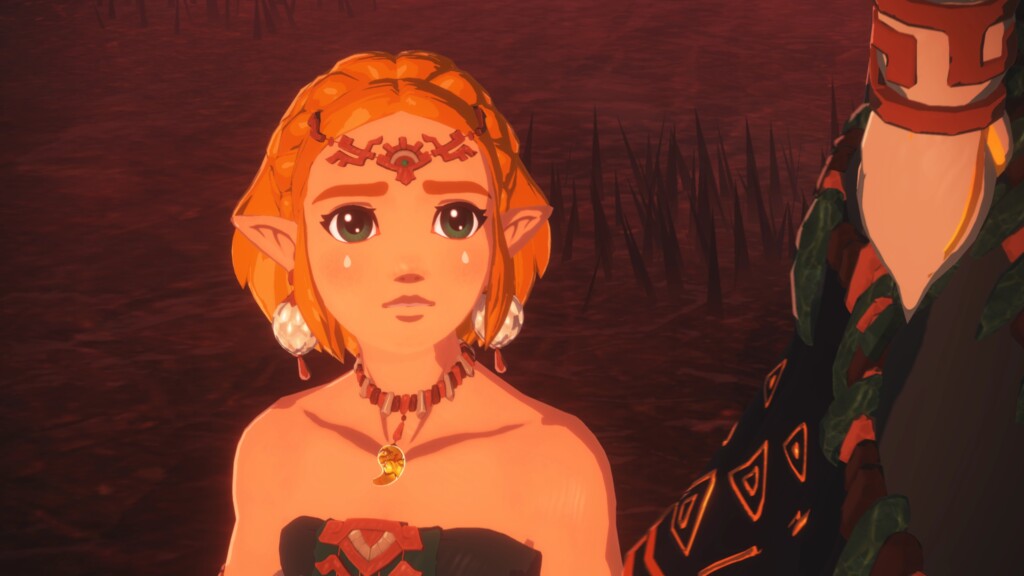
And now, here we are with another Musou game from Koei Tecmo that aims to provide the backstory of The Legend of Zelda: Tears of the Kingdom, or, in other words, show us what Princess Zelda’s got up to after she fell down a hole and travelled back in time.

That framing suggests that narrative will be central to Hyrule Warriors: Age of Imprisonment, and so it proves. But make no mistake, this is a full-blooded Musou game. The surprise to me is just how well the game balances the cut and thrust of intense action with a lore-rich and surprisingly heartfelt story.
Where Age of Calamity is ultimately regarded as an enjoyable what-if, Age of Imprisonment slots more seamlessly into the canon. The story dives headfirst into the past, with King Rauru and Queen Sonia initially taking centre stage to school an out-of-time Princess Zelda, who once again carries the emotional weight of the narrative. As the story progresses – and there will be no spoilers here – we get to see first-hand why this series has the title “The Legend of Zelda”, even if this particular game is shorn of that moniker.
Following her powerful role in Tears of the Kingdom and a star turn in Echoes of Wisdom, it’s a delight to see Zelda now firmly established as an equal lead. I have always been a fan of Patricia Summersett’s performance, and here, she is as stirring as ever. This franchise isn’t just Link’s story anymore, and it’s all the better for it.
It’s remarkable, really, that a story so important to recent franchise history plays out against a Musou game of all things. For a long time, this was a form of action game I considered somewhat mindless, but consider me also schooled, because Hyrule Warriors: Age of Imprisonment presents a wide-ranging but easy-to-grasp combat system that incorporates aspects of Tears of the Kingdom while offering spectacle and depth. Bravo to Koei Tecmo, honestly.
The core remains a simple branching – but expandable – system of attacks tied to the Y and X buttons, but it’s supplemented by a range of special attacks unique to each controllable character, a range of Zonai devices taken from the source material, and some delicious team combos called Sync Strikes. There’s a lot to take in, but the game treads the line of complexity and accessibility perfectly, and offers just the right amount of on-screen prompts to keep things clear.
The Zonai devices are a particular treat – woven into combat, and traversal seamlessly – and are much more than the gimmick I feared. The result of these interconnected systems is a cacophony of on-screen action that is visually spectacular and superbly directed, with pauses, cuts and glorious animations to highlight dramatic moments. The high-5 between characters before each Sync Strike never ever gets old.

Gameplay repetition is always a threat for this genre, but the expansive cast of characters unlocked through story progression and side missions mostly ensures that the action does not become stale. Variety also plays a part with a decent mix of mission structure and length. The 2014 original often felt like a plate-spinning slog, but not here. In fact, it’s the intensity of the Musou gameplay that makes it the perfect fit for a story of this scope.
Frequent narrative breaks also provide the right amount of downtime between missions, as does a simple crafting and economy metagame accessed from Hyrule’s map. Battle spoils feed into weapon upgrades and narrative side stories, all managed from the same screen, with mission selection and territory control helping to paint the picture of a large-scale war

It was the scale of things that hobbled the game’s predecessor, Age of Calamity. That title struggled with the sheer weight of the action on the original Switch, but there are no such concerns this time. Character models are sharper, environments are richer, and there’s a lovely painterly haze to the ancient Hyrule setting. The Switch 2 hardware lets the game throw dozens of enemies at you without a hitch in performance. It might not be the most ambitious game visually, but it’s a clear technical step up from its predecessor and looks great both handheld and docked. The cutscenes are also rendered and scripted with a cinematic flourish and an overall level of care that helps to cement the game as canon.
Hyrule Warriors: Age of Imprisonment proves to be the perfect companion piece to Tears of the Kingdom by contributing to that game’s mythic scale in a way that doesn’t feel cheap or inessential. The one downside, if it can be called that, is that the game’s reuse of locations, iconography, characters, and sound effects can inadvertently make you pine for Nintendo’s 2023 opus, especially because now it has its own spectacular Switch 2 upgrade. Every time I uncovered a hidden Korok in Age of Imprisonment, it was a guilt-inducing reminder of those left unfound in the main game.
A genuine and delightful surprise, then. In terms of narrative and action, Hyrule Warriors: Age of Imprisonment sticks the landing, continues the Switch 2’s excellent run of year-one exclusives, and makes a stronger case for the Musou formula than any Nintendo spin-off so far.

Game: Hyrule Warriors: Age of Imprisonment
Platform: Nintendo Switch 2
Developer: Koei Tecmo
Publisher: Nintendo
Release Date: November 6, 2025