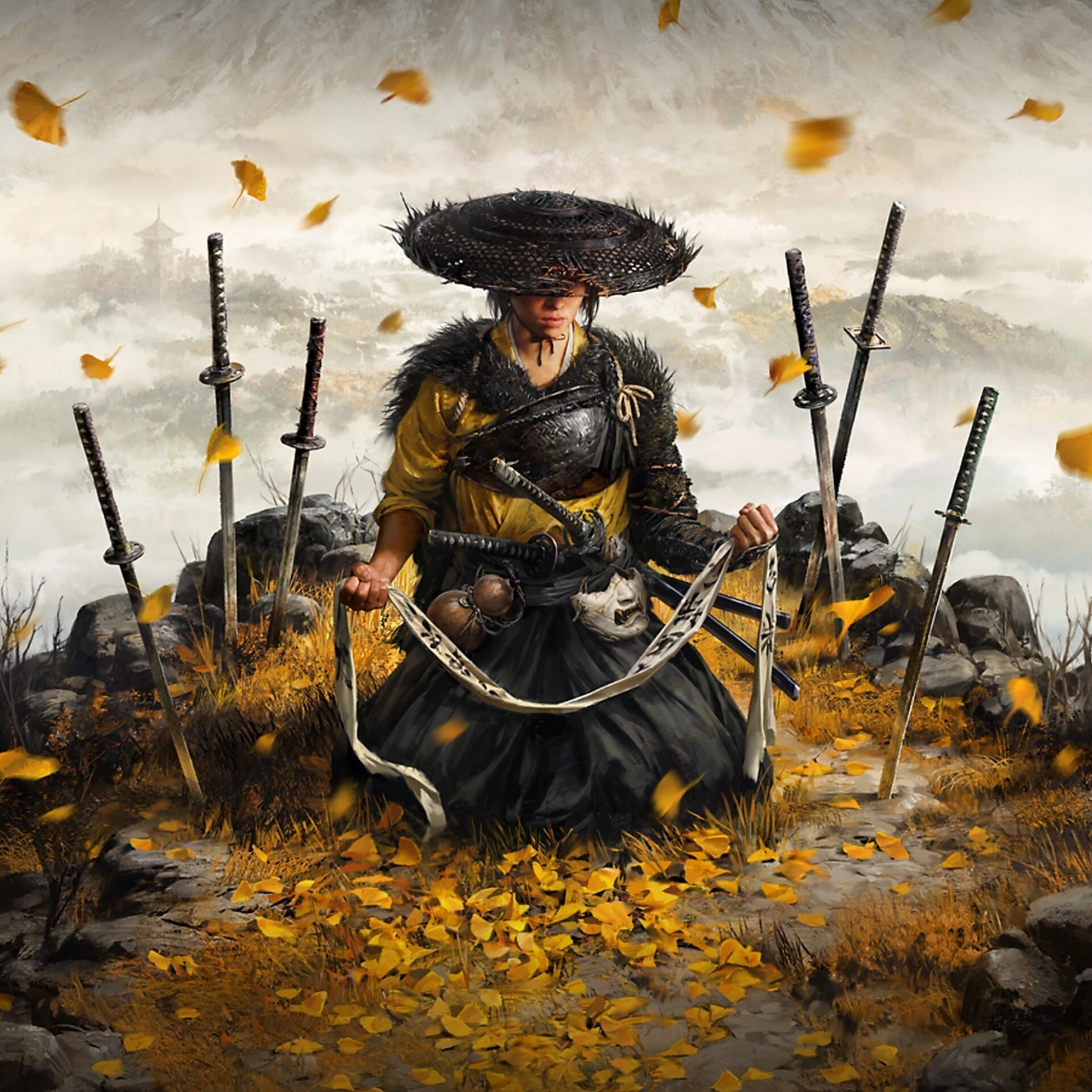


At GDC Festival of Gaming, Sucker Punch’s Ariadna Martinez revealed how a narrative-first rethink turned Ghost of Yōtei’s open world from something players ignored into something they actively explored.
With video game open worlds becoming increasingly large, and increasingly populated with activities, how do you ensure that any given piece of content actually gives the player something worth having?
Ariadna Martinez, Senior Writer and Narrative Designer at Sucker Punch Productions, spoke about that challenge in a GDC talk titled Meaningful Reasons to Wander: Creating Open World Engagement in Ghost of Yōtei.
Martinez began by outlining the three main categories of open world content: quantity, variety, and value. The third is the most important, she says, because if that one collapses, it drags everything else with it.
“Does the piece of content matter enough?” she asks. “I mean if your players interact with this piece of content, will they find a reason? Will they find motivation? Will they find information that allows them to go engage with other pieces of content in your world? Is this piece of content just another checkbox on a long list of repetitive content, or does it actually provide the tools to engage with your progression systems?”
The question sounds obvious until you realise how rarely some open world games actually answer it.
The Wrong Target
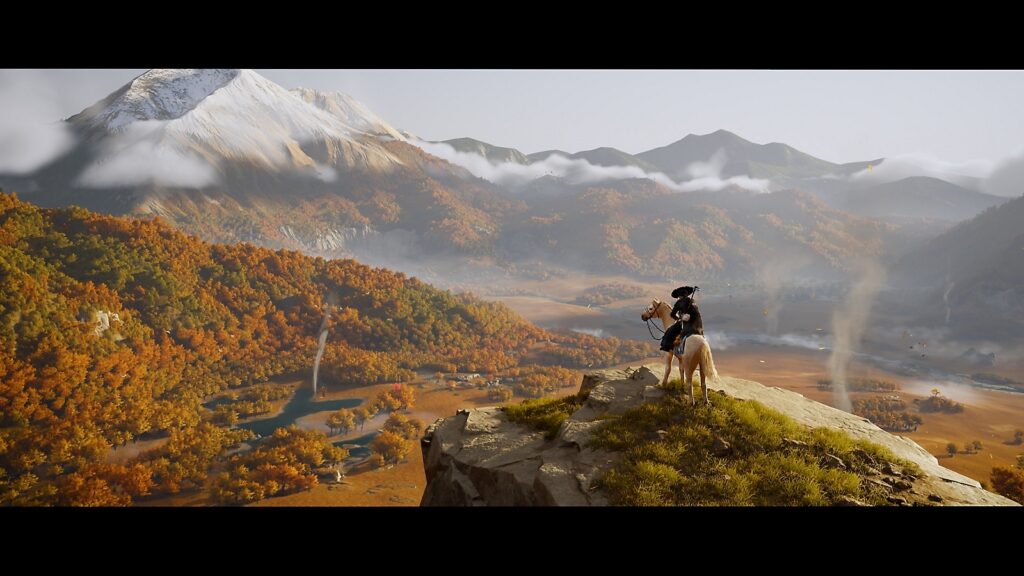
When Martinez joined Sucker Punch in May 2023, she saw that Ghost of Yōtei had a clear creative direction and was shaping up to be something special. But when the game went to testing, some of the data was troubling. Players weren’t wandering. Instead, they were sprinting directly to the main story and ignoring the open world almost entirely. It wasn’t a volume problem, however. Test data showed players were finding the content, but they weren’t finishing it.
“That’s the biggest red flag for me right there,” Martinez says. “And once they left, they didn’t know where to go. So they went for the main quest, because that is the lifeline.”
Everything from making combat easier to simplifying the progression system and improving the points of interest was on the table as a possible solution. These were all reasonable instincts, Martinez says, but as it turned out, they were aimed at the wrong target.
“The problem was 100% a narrative design problem. It was about how we were conveying information to our player.”
To illustrate, Martinez walks through an early encounter that is, on paper, perfectly fine. You approach a group of thugs harassing an innocent civilian. You fight them. You win. The person you rescued is dead. You move on. Video games can be fun like that, but, says Martinez, what value did the interaction give the player other than an enjoyable moment of action?
“Did they get any information that allows them to engage with the game, whether that be design or narrative-wise? Did they learn anything about our factions? Did I learn anything about where I am? Not really. Did I learn anything about our progression systems? No. Did we learn anything new about our main character? No.”
In this example, the player left empty-handed and went looking for other pieces of content in the hopes that they would get some information.
The Cone of Entry
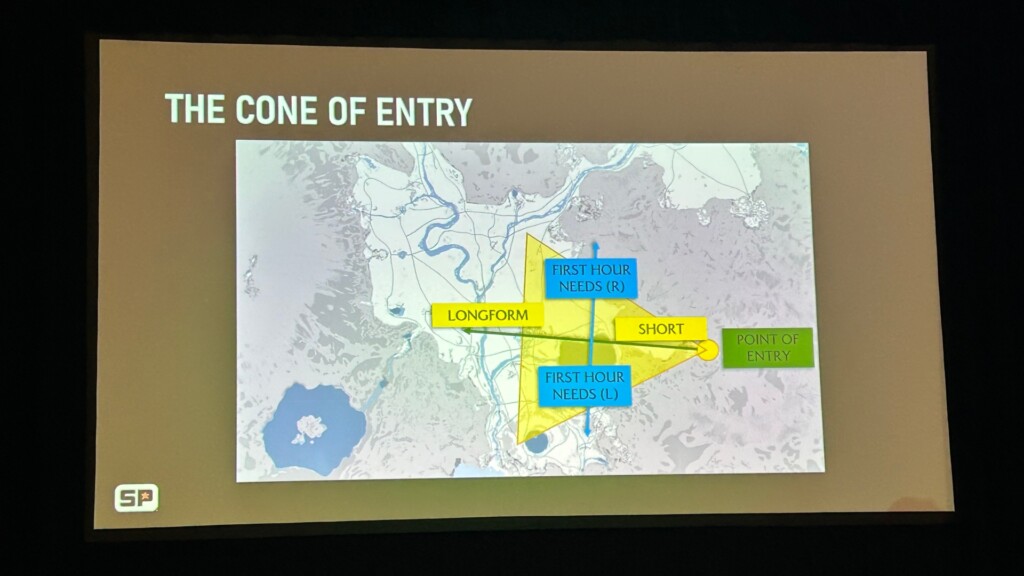
The fix Martinez and her team devised was elegant and simple, though the execution required considerable cross-departmental trust. She gathered first-hour needs from every team with a stake in the player’s early experience, from systems and combat to narrative and design, and created regional content guidelines. This document tracked tone, faction information, gameplay scenarios, and the specific things players needed to understand to engage meaningfully with the world. The resulting concept, after much iteration, was called the cone of entry.
Working out from the player’s entry point on the map, Martinez identified where players are likely to be within their first 20 to 30 minutes.
Distance from the entry point, she explains, determines content density. “The closer a piece of content is to that point of entry, the shorter you want it to be. Five minutes, one or two gameplay verbs, one or two pieces of content, enough that they can digest that information and move forward looking for more. And the further in they go, the more information they get, the more they understand how to engage with the game, the longer the pieces of content can be, the more information you can put in front of them.”
A Shared Language
Another insight concerns what Martinez describes as the diamond, the idea that the same core piece of information can be delivered through entirely different scenarios without feeling repetitive.
“If you think about information, a piece of information as a diamond, a diamond has facets. You can look at diamonds from different perspectives. And they look different from those different perspectives. So if I give you the same piece of information, but I give it to you in completely different gameplay scenarios, from the point of view of completely different factions, in completely different contexts, it will feel like a fresh piece of information.”
The changes themselves were often remarkably small. That early encounter with the thugs and the dead civilian became a masterclass in micro-rewrites. New combat lines established Atsu as a wanted woman, with enemies recognising her on sight and making clear the Yōtei 6 were already hunting her. The rescued civilian was kept alive and given a wrap-up conversation to let the player know where they were and that an inn was nearby.
“If the players hear inn, they hear hub, they hear vendors, they hear progression. They have something to look out for,” Martinez says.
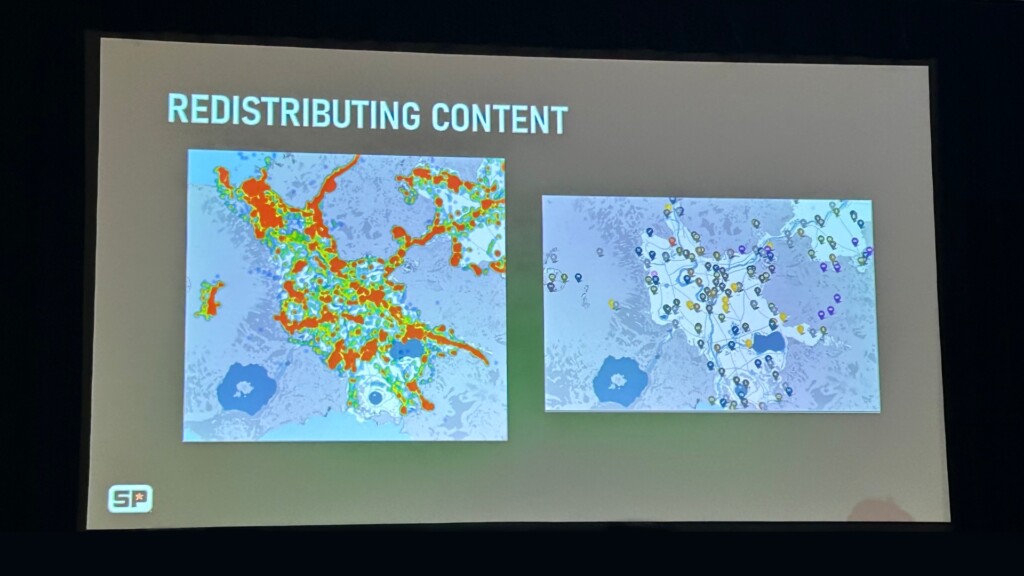
The results were positive. In the first playtest, 20 players across two days completed 317 pieces of content in the first region. After the narrative design pass, those same players completed 764 pieces of content, a 141% increase.
“The open world got hit with a good old dose of narrative design,” says Martinez.
The pipeline Sucker Punch built around this principle gave every team a shared language for what content needed to do, not just what it needed to be.
Narrative design, Martinez concludes, is not a department or a job title, it’s a tool. One that any designer, on any project, can pick up. “You don’t have to be making a AAA game,” she says. “You can use it for your smaller teams. You can use it when teaching. You can use it in any scenario. As long as it’s all about helping each other communicate things to a player.”
Ghost of Yōtei needed a world full of reasons, not just things to do. Narrative design was the right path.
Read more reports from GDC Festival of Gaming 2026.